 Kuulo
KuuloA growing CRM serves thousands without losing structure
A multi-customer CRM preserves workspace separation, flexible records and governed automation while serving thousands of businesses every working day.
Value delivered
Thousands of small and medium businesses use the live CRM every working day, with each workspace able to adapt to its own workflow.
A growing CRM cannot make every customer solve the same problem in the same way.
The platform behind thousands of daily users has two obligations that pull in opposite directions. It must feel flexible enough for each business to run its own workflow. It must also keep customer records, permissions and automation structured enough to operate as one dependable service.
We delivered that foundation for a live CRM used by thousands of small and medium businesses every working day. Each customer can connect correspondence, define useful objects and fields and run workflow automation inside its own workspace. The platform can continue serving a growing user base without turning scale into a reason to flatten every customer's work into one rigid template.
Client background
Our client is a listed business software group with a live CRM product and a growing user base. The CRM is not an internal tool used by one sales team. It is a multi-customer platform where different businesses need different records, permissions, processes and customer views.
That makes the operating model part of the product experience. A customer should be able to mould the CRM around its work, while another customer's information remains inaccessible and the common platform remains maintainable.

Business challenge
Scaling a CRM is often described in terms of storage or message volume. Those are real engineering concerns, but they are not the reason a customer keeps using the product.
The customer-facing challenge is preserving usefulness as the platform grows:
- one business needs different objects from another;
- each workspace has its own contacts, correspondence and permissions;
- automation must act on the right customer's records;
- connected tools must receive governed context rather than an unfiltered data dump;
- and product changes must not break the working day for existing users.
If the platform solves scale by forcing one universal process, it loses the flexibility that made it valuable. If every customer becomes a completely separate custom build, the service becomes too hard to operate and improve. The client needed both product-level consistency and customer-level fit.
Implementation
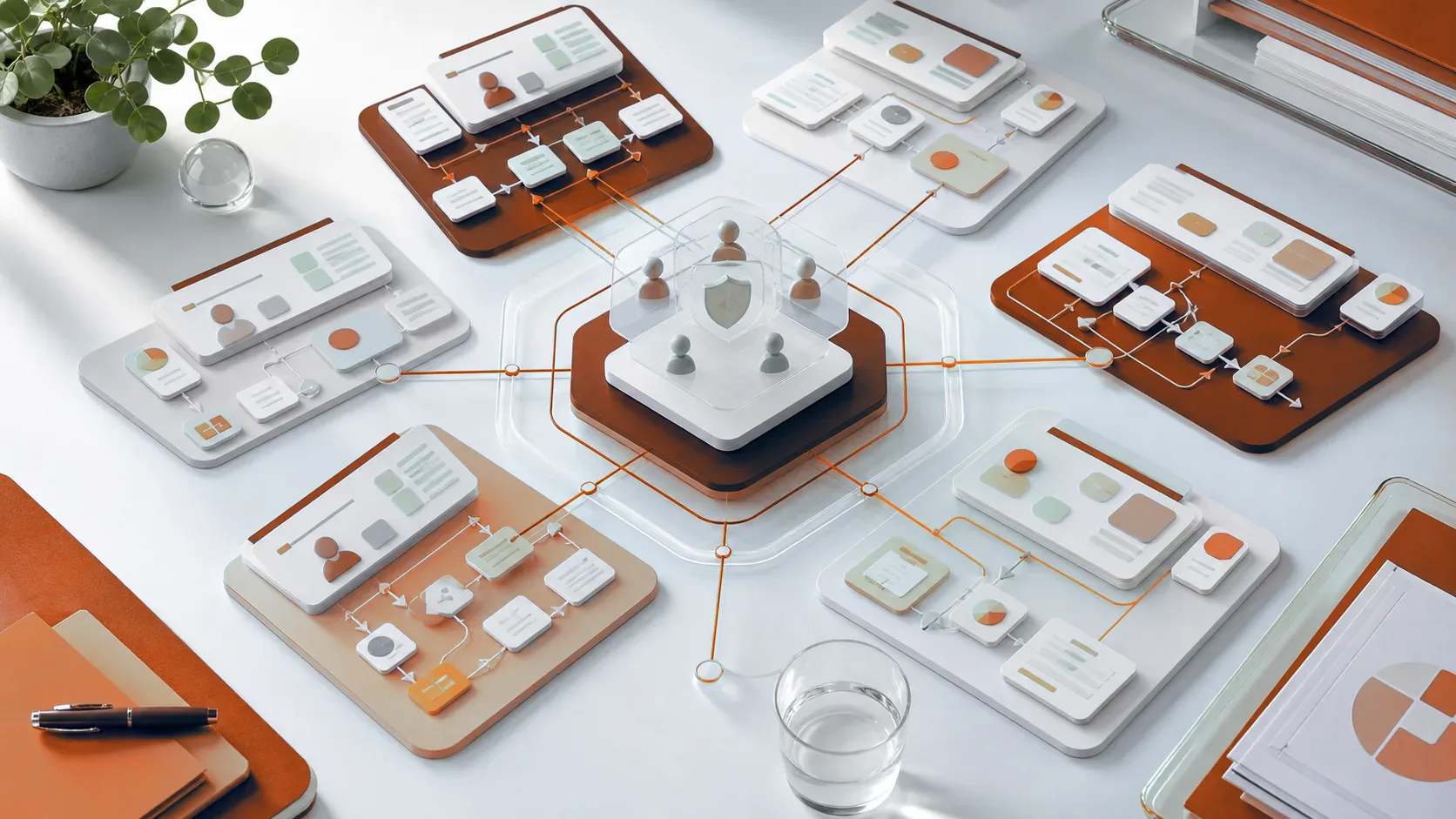
We built the CRM as a multi-tenant service. In plain English, one product supports many businesses, while each customer's data, workspace and permissions remain separated. That boundary applies to customer records, email context, custom objects, fields and automation.
Mailbox synchronisation connects each user's live correspondence to the appropriate customer workspace. The CRM can then enrich contacts, prepare follow-ups, flag stale accounts and answer questions using the context that belongs to that business. The same structure supports campaigns, open and reply tracking and routine workflow actions.
Custom objects and fields provide the local shape. A customer can model applications, cases, partners, renewals or another workflow without making the product abandon its shared foundation. Plain-language automation lets process owners change routine actions inside those boundaries. The Model Context Protocol (MCP) gives connected tools access to structured CRM context without making the CRM another uncontrolled export.
The platform also handles a high-frequency stream of documents and emails. That infrastructure matters because stale or incomplete context is not useful to a customer. The commercial result, however, is simpler: the information needed to act remains available in the workspace where the customer expects to find it.
Why it was difficult
Multi-customer flexibility creates failure modes that a single-company tool can avoid. A search must return the right workspace. An automation must not cross a customer boundary. A custom field must be usable without making common reporting impossible. A product update must preserve the workflows that customers have already moulded around the system.
The platform therefore needed structure at several levels: tenant separation, permissions, customer objects, live correspondence and predictable workflow execution. Scale was achieved through those boundaries, not by asking customers to give up the way they work.
Value delivered
- Thousands of small and medium businesses use the CRM every working day.
- Each business can operate in a separate workspace with its own customer context and permissions.
- Custom objects and fields let customers mould the product to their workflow.
- Mailbox synchronisation, follow-up, campaigns and tracking share one structured customer view.
- Plain-language automation is available inside the right data boundary.
- MCP makes structured CRM context available to connected tools without removing governance.
- The platform remains live and continues to evolve as the user base grows.
The value of the architecture is visible in the user's day. A CRM can grow in the number of people using it without growing the number of places each person must search before acting. Each customer gets a workspace that fits, and the platform team gets a common system it can operate responsibly.

What this means for your business
If a growing customer base is forcing a choice between flexibility and control, the solution is an operating model that makes both explicit. Separate customer boundaries protect trust. A flexible record model protects adoption. Connected workflows protect the time between information arriving and someone acting on it.
That same approach supports multi-entity insurance, financial platforms, recruitment networks and property operations. The transferable outcome is not a claim about message volume. It is a live service that grows without losing the structure customers rely on.
Related: Platform engineering · Systems integration · Fintech scale-ups