 Kuulo
KuuloConstruction leaders stop paying twice for the same expertise
A structure-led knowledge system connected projects, people, decisions and evidence so experience could move across the company.
Value delivered
Relevant experience can be found through the project and work package where it was created instead of relying on one person's memory.
Construction companies often pay for the same expertise more than once without realising it.
One project manager remembers how a local requirement was handled. One compliance officer knows which evidence satisfied a previous review. One delivery lead remembers which work package caused a similar delay. When the next project cannot find that knowledge, the company repeats the research, the coordination and the mistakes.
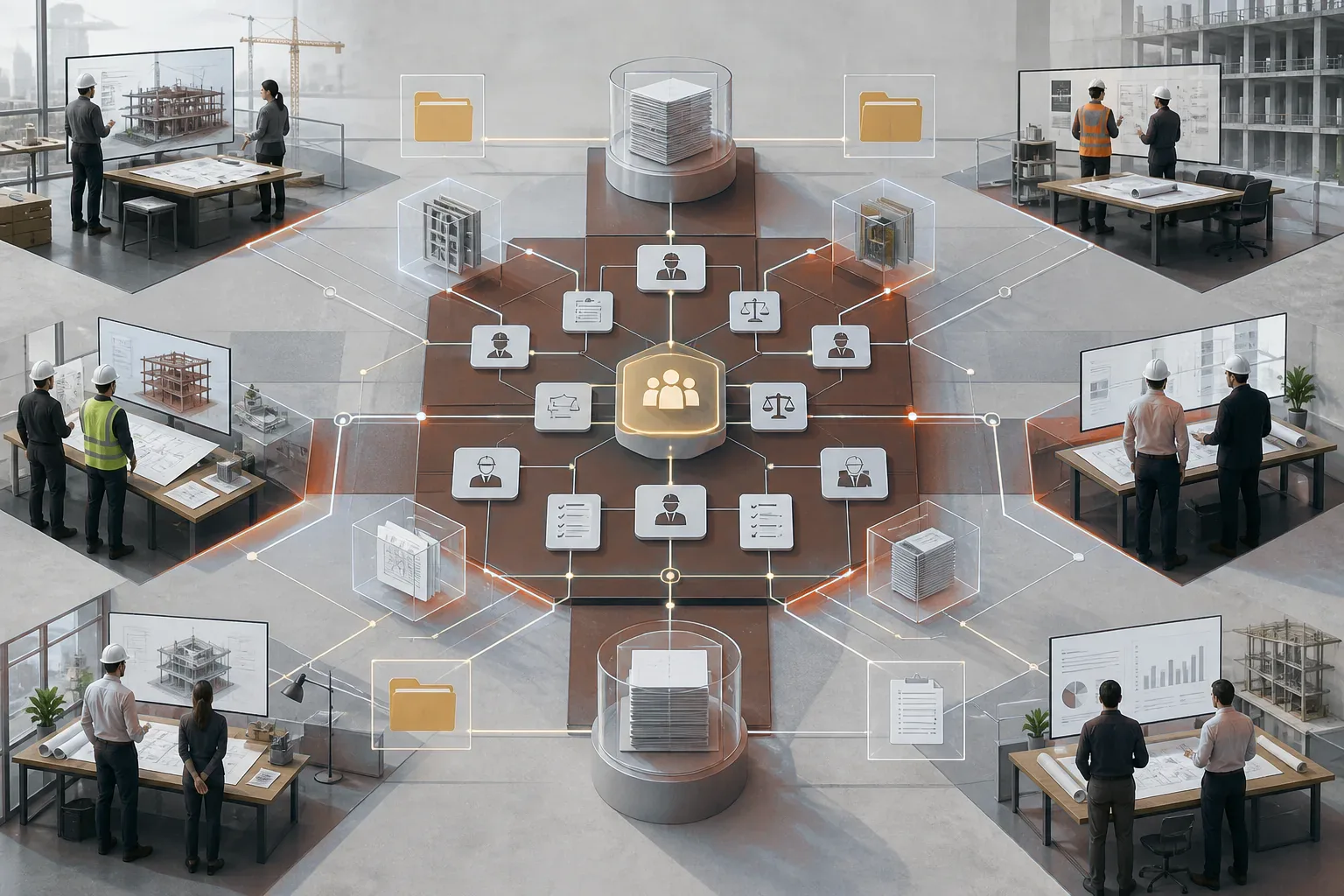
We delivered a structure-led knowledge system that connects projects, people, work packages, decisions, documents and dates. The result is company governance that does not depend on one person's memory. The right experience can move to the next project because the organisation knows where it was created and how it relates to the new work.
Client background
Our client is a large construction company delivering public bridge contracts, housing developments and other multi-site projects. It has different project teams, local requirements, contracts and commercial events moving at the same time.
The company had expertise. It did not have a dependable way to transfer that expertise across the company without asking people to remember, search or repeat the work themselves.
Business challenge
Knowledge silos are expensive even when every individual team is capable. A project can complete a useful piece of compliance research, solve a delivery problem or identify the commercial effect of a disruption. If that result stays in a project folder or with one person, the next team starts again.
The consequences appear in several places:
- HR cannot easily find who has relevant experience;
- delivery teams repeat problem-solving already completed elsewhere;
- compliance officers rebuild the same local understanding;
- project managers cannot connect a current delay to a prior decision;
- leadership sees duplicated effort without seeing the knowledge that could have prevented it.
The company needed more than document storage. It needed a shared structure that could answer who worked on what, which decision was made, what evidence supported it and where that experience might be useful next.

Implementation
We connected the company records that make experience reusable: project, site, municipality, contract, work package, person, role, date, decision and source document. A piece of knowledge is no longer only a file. It has a place in the work and a relationship to the people who created or used it.
RAG retrieves relevant source documents for a question, while the structure preserves the context around them. A compliance officer can ask what was done on a similar project and find the source, date and responsible person. A delivery lead can find who worked on the relevant bridge or housing work package. HR can support resource planning with experience connected to actual work rather than a private contact list.
The system also keeps operational events connected to the project timeline and cost records. That means knowledge transfer does not stop at a document. A later team can see how a decision affected the schedule, work package or commercial outcome.
The governance model is structure-led. People still make the judgement and approve the current requirement. The structure carries the context so the company does not have to rely on one person being available or one team keeping a private version of the truth.
Why it was difficult
Company-wide knowledge transfer has to respect boundaries. Personnel information and sensitive project documents should not become a loose folder available to everyone. The system needed to make relevant experience findable while keeping permissions and source ownership meaningful.
It also had to preserve the difference between experience and approval. A prior project can explain what happened. It cannot automatically decide what the current project should do.
Value delivered
- Project, site, contract, work package, person, date and source stay connected.
- The next team can find who worked on a relevant project or work package.
- Compliance knowledge can move between comparable projects without relying on personal memory.
- RAG makes relevant source documents easier to retrieve.
- HR and delivery teams can support knowledge transfer across the company.
- Governance becomes structure-led while professional judgement remains with the responsible people.
- Repeated work is made visible as an organisational cost instead of an unavoidable habit.
The value is a company that can reuse what it already knows. It does not remove the need for experienced people. It lets their experience travel further than the project where it was first learned.

What this means for your business
If a process depends on finding the person who remembers the last case, your organisation has a people problem only on the surface. Underneath it has a structure problem. Connect people to the work, decisions and evidence that make their experience useful.
That pattern applies to engineering, accountancy, insurance, legal matters and property operations. The outcome is not a bigger intranet. It is governance that turns individual experience into shared, traceable capability.
Related: Knowledge systems · Workflow automation · Construction companies