 Kuulo
KuuloOne customer tab replaces the hunt across inboxes, CRM tools and spreadsheets
A flexible CRM turned fragmented customer work into one structured workflow, with tested daily processes moving from hours to minutes.
Value delivered
Tested daily CRM workflows moved from hours to minutes, while the live platform continued serving thousands of businesses.
The team did not need another place to store customer details. It needed to stop searching for the conversation before it could act.
For this business software group, customer-related work was spread across individual inboxes, an existing CRM, spreadsheets and manual reminders. The record might be in one place, the latest email in another and the next action in somebody's memory. The work was familiar, but the route through it was not.
We built a flexible customer relationship management platform that puts the record, correspondence and next action in the same working view. In testing, daily workflows that had taken hours moved to minutes. The important result was not the amount of email the platform could process. It was that a team could see what mattered and move it forward without reconstructing the context first.
Client background
Our client is a listed business software group whose CRM platform is used by thousands of small and medium businesses every working day. The product has to work for many different kinds of customer without turning each new workflow into a separate software project. It must be structured enough to be reliable, but flexible enough for each business to make it fit the way it actually works.

Business challenge
The starting point was fragmentation. Customer emails and related tasks were not consistently available beside the customer record. A salesperson or account manager could spend the beginning of the day answering questions that should have been visible in the system:
- What did the customer last ask for?
- Has anyone replied?
- Who owns the next step?
- Which accounts have gone quiet?
- What needs to happen after this message?
The cost was not just inconvenience. People were spending skilled working time searching, copying, checking and remembering. Manual workflows in spreadsheets or existing CRM processes could take hours. When the daily process depends on a person keeping the whole chain in their head, follow-up quality also depends on who happens to be available that day.
The client needed a live product that could serve a growing customer base, keep each customer's data separate and let ordinary users adapt the workflow without waiting for a developer.
Implementation
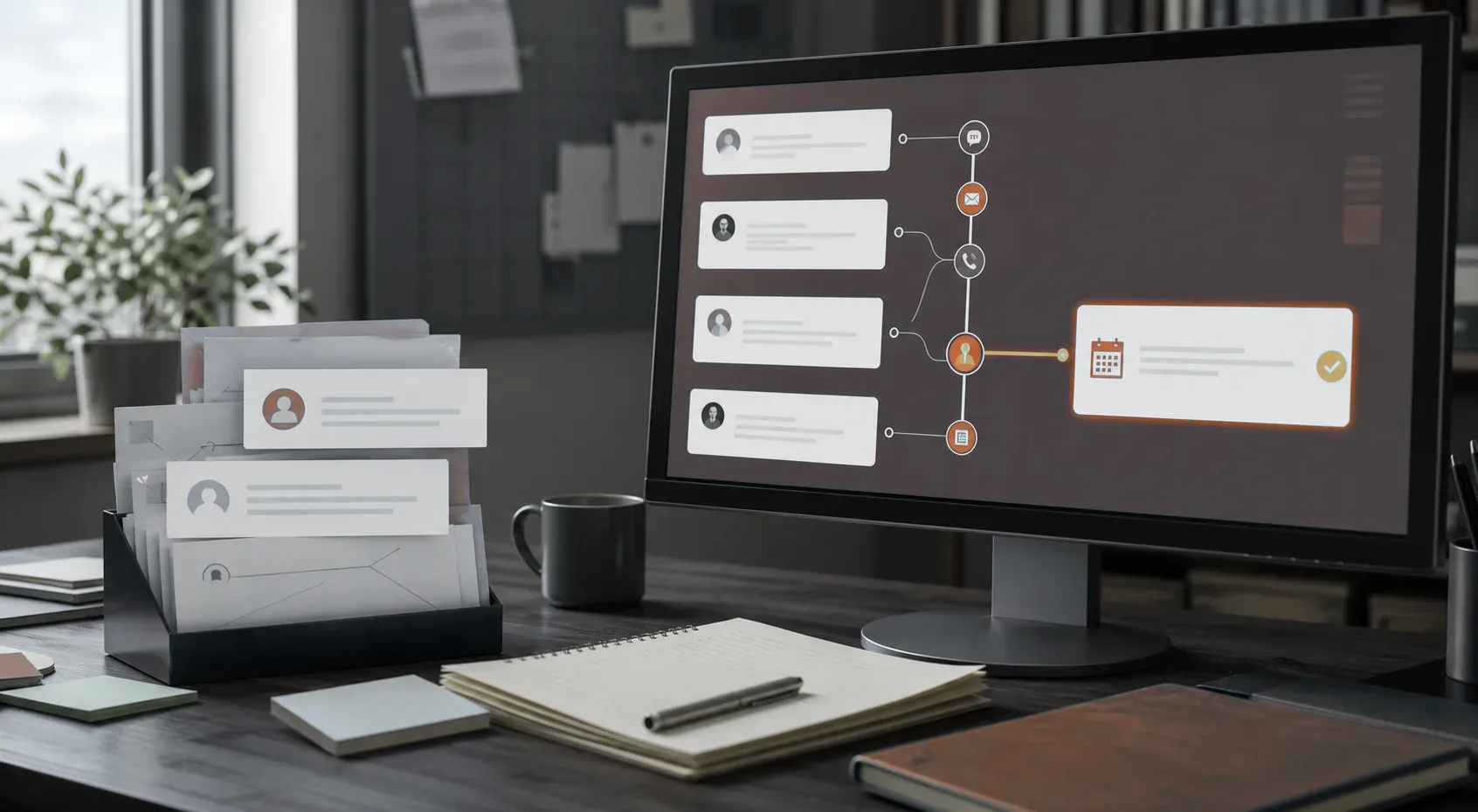
We connected each user's mailbox to the CRM and structured the incoming correspondence against the customer record. That gives the team a single place to see the conversation, its context and the work that follows from it.
The platform then turns that context into visible work. It can enrich a contact, identify a stale account, prepare a follow-up and answer a question in plain language. A person still decides what to send and what to do. The difference is that the person starts with the relevant context instead of starting with a search across several tools.
We also built routine workflow automation. A user can describe a repeated process in ordinary language, then configure the actions, conditions and permissions that govern it. This makes the system useful to the people who own the process, not only to the technical team that maintains it.
The data model is deliberately flexible. Custom objects and fields let each customer represent the records and relationships that matter to its business. One company may need a customer and renewal view. Another may need accounts, applications, cases or partner relationships. The platform can change shape without losing the structure that makes the data usable.
Structured CRM context can also be made available to connected tools through the Model Context Protocol (MCP). That is an implementation detail, but it matters when the next workflow needs to use the same governed customer information rather than create another disconnected copy.
The platform is multi-tenant, meaning one product serves many businesses while keeping each customer's workspace, permissions and data boundaries separate. It is operated as a live product, including a second branded deployment.
Why it was difficult
Connecting an inbox is not the hard part. The hard part is deciding what the message belongs to, which context should travel with it, who can act on it and how the workflow stays reliable across thousands of separate businesses. The correspondence, record, automation and next action had to become one daily workflow without removing human judgement.
Value delivered
- Customer correspondence, record and next action are available in one structured workspace.
- Tested daily CRM workflows moved from hours to minutes by removing repeated searching, copying and checking.
- Users can configure routine follow-up without waiting for a developer.
- Custom objects and fields let each customer mould the platform to its workflow as the business grows.
- The product serves thousands of businesses every working day while keeping their workspaces and data separate.
- The platform remains live and extendable rather than becoming a one-off implementation that the customer is afraid to change.
The scale figure proves the platform is operating in the real world. The reason a customer buys it is simpler: people can find the context behind customer work and act on it in minutes.

What this means for your business
If your team spends the first part of every day searching email, checking spreadsheets or asking who owns the next step, the problem is not a lack of another CRM feature. The problem is that the workflow is split across systems that do not share enough context.
The same pattern applies to client onboarding, renewals, applications, candidate communication and case management. Connect the live correspondence, structure the records around the work and let the people who own the process shape the workflow. The result is a system that takes over the repetition without asking the business to give up the judgement that makes the work valuable.
Related: Systems integration · CRM engineering · Insurance brokers and MGAs